Showing posts with label Varadero. Show all posts

Friday, September 5, 2014

Blue View on Communications

Where do I start on communication!  That's the real question.  Before we started cruising last year we had a million questions and very little answers.  Linda will vouch I spent countless hours searching, surfing and digging for communication answers.  Our main goal was, how can we keep in touch with family members and be safe. Needless to say there are as many answers or opinions out there as there are sailors.  Well guess what! I'm going to add one more.   


By the time we were ready to leave the North Channel in August 2013 we still had no answers as to what would be the best communication system for us. So our decision was to start cruising with a cell phone and our VHF radio. Some people may say it was irresponsible but remember we were leaving from the North Channel of Lake Huron to Lake Michigan traveling via the river system to Mobile Alabama followed by coastal sailing. The weather can get very nasty but we would have good communication via VHF and cell phone in the US.

So let's see what's out there for communication:
1) VHF Radio: maximum range is about 25 NM. Initial cost is minimal, approximately $200.00 and is must for any vessel.  I would not be without one.
2) SSB short for Single Side Band Radio: range is unlimited, but the cost is high,
averaging $3000.00 or more for a new system and you need a licence.
3) SSB receiver: range is several hundred miles and the cost is approximately  $300.00 
4) Satellite Phone: anywhere depending on the provider. Again high cost and often people only use it sparingly and for emergency. The cost can be anywhere from $500 to $1500 for the phone and then so much per minute depending on the plan purchased.
5) Cell phone: the phone and usage costs varies considerably from $20 to hundreds depending on the cell service provider and plan. Cell phones are great, but when traveling outside your home provider area the roaming charges can be very expensive.  You can purchase an unlocked phone which will work with any provider when you buy a pay as you go SIM card in each country or area you're traveling in. I can't give you the cost of plans in various counties as cost are unlimited. 
6) Internet, you can use it to call home with programs or apps such via Skype, Magic Jack or FaceTime.  Often we had service readily available in most areas or marinas. Often, you can get internet for free at the marina you are docked at or for a fee about $5 to $20 for the day. A lot of bars or restaurants will have free internet for their customers.  
7) Internet booster antenna: will cost a couple hundred dollars and will often capture the internet from businesses or other sources while at anchor. ( Once I managed to get an unlocked internet almost a NM away). 
8) Spot tracking device: will provide accurate location and tracking via satellite anywhere and is capable of sending short pre-program text. Cost is a couple hundred dollars for the device plus a fee anywhere from $50.00 to $300 membership per year.
9) InReach tracking and communication device: will provide accurate location and tracking via satellite anywhere and is capable of sending detailed text and Facebook massaging. Again cost is about $300 for the device plus a fee anywhere from $20 to $70 per month membership. InReach can also provide a Satellite  phone with an unlimited plan for approximately $1800.00 a year

I'm nowhere near an electronic genius.  I'm only a sailor trying to make sense of what would work for us.  I'm sure I missed some systems out there and my pricing may be off a little as you can add or change plans.

My point is "The sky is the limit" or should I say "Your bank account is the limit". 

I have nothing against all these systems and wish I could afford allot of them, but we are retired and on a budget.  When we sold everything and left Ontario I really liked the fact that we didn't have any monthly bills or bills period.  

OK you're probably saying, get to the point.  Well here it is, after a year of cruising in the US, Cuba and Mexico this is what I found.

We tried the US Pay as you go cellphone for a few months,  It worked ok, the plan was unlimited long distance calls to USA and Canada but, and there's always a but, It didn't included calling Canadian cell phones.  I don't know of anybody out there that is not using a cellphone, so that didn't workout too well for us.  

In Cuba communication of any kind was pretty well non existent.  You could not use any foreign cell phones.  The internet is controlled by the government and you must use their computers.  The cost is $6.00 CND for one hour. It is extremely slow and frustrating.  Phone calls cost $10.00 CND for 10 minutes. So no big conversations.  The call was, we are here, all is good and we will try to send an email if we can.  

Mexico was totally opposite to Cuba.  Cell, internet, public phones were all readily available. At a reasonable cost of course.

After using a few devices and talking to other cruisers. Here's what we are using and worked for us.

We found that while traveling a good VHF was a must to stay in touch with other vessels, listening to weather and calling the Cost Guard if needed.  On some days we even managed to listen the weather forecast from Florida in Cuba. 


Our biggest issue was trying to get the weather if no internet was available.  So we purchased an SSB receiver.  You don't need a licence, the cost is minimal, all you have to do is hoist the antenna to hear other vessels, cruiser's nets and weather forecasts.  
Last but not least, the internet.  We stayed in communication with family and friends via Skype, FaceTime, Magic Jack, or posting on Facebook and our Blog.  To help reception we purchased a WIFI boosting antenna. Once set up with a wireless router on board all our devices could be used.  We often chatted on the internet while we sat at the dock or anchor.
Remember our goal was to stay in communication without blowing our retirement budget.  We found we didn't need to stay in contact at all times.  It was very liberating not to be attached to a cell phone or texting. It was a little harder for our family and friends but they understood and got used to it.  We are finding our only shortcoming if an at home emergencies arises, family would struggle to have immediate communication.

Of course in case of an emergency while coastal cruising our vessel is equipped with a registered EPIRB device. 

Hope this post helps you in your cruising.

Blue View Signing Out.

Monday, February 17, 2014

Varadero Cuba 24 December 2013 to 20 January 2014

We left Marathon Florida at 15:00 23 Dec and crossed the Gulf Stream to enter Cuba at 10:00 24 Dec Christmas Eve day. We spent three hours clearing customs which was relatively fast. Took our first cold Cuban shower and rushed to Memories Resort to meet Kevin, Paula & the boys. Their resort was lovely, drinks cold, company amazing. This quick eight hour visit was the best boost I could have had and a definite cure to my home sickness. The gang left at 07:30 the next morning. 


Nick Kevin Paula Jamie Adam 


Me and the guys :)


Marc & I Memories Resort


Christmas Dinner we love you guys

So since Christmas we have been exploring the Cuban culture. Are learning to live on the boat in a foreign country. Enjoying the fantastic weather (I am thankful for the prevailing east winds cooling me off). Of course we have shared rum & laughter with other cruisers. Visited Trinidad (Cuba), Santa Carla, Ceienfuegos, hiking in the El Nicho rain forest, Marc swam in waterfalls. We have danced. Explored white sand beaches. On the flip side we struggled to communicate in the market for produce I don’t recognize. Do laundry by hand. Cold showers and limited toilet paper. I Love Cuba. 


Varadero is famous for its miles and miles of white sand beaches. The east end of the peninsula is the luxury hotel zone.


Chaska shops abound to find souvenirs


Marina Darsena 

Marina Darsena was a great introduction to Cuba. The crossing from marathon was doable. Entering at a small marina seemed to be relatively easy especially with the wealth of information from Marina locals and seasoned Cuban cruisers. Ismeli the marina manager is helpful and welcoming. Debbie Armstrong a pleasant go to for much needed local knowledge. Also, yacht pilot's cruising guide is invaluable. Clearing customs wasn’t even as painful as we expected. 
Some quick observations: 
The marina is worn needing upgrading. We each enjoyed one hot shower in 27 days. There was no lighting in the showers and toilets need repairs. The ritz it isn't.  The security is excellent. Free ice. No laundry facilities. It is a good 25 minute walk but well worth it to get to the beach. Having bikes for transportation is a bonus. 


The Berm Varadero Style 
Much the same as home good people, cold rum, yummy snacks. Just more nationalities. 


One of my favorite outings of the week was going to the market. We always went on Sundays because it was the biggest market of the week. The first time we went, we went with Debbie a Canadian that has lived in Varadero for 13 years. To say I was intimidated is an understatement. But Debbie's savvy and spanish rescued my butt. By the end of four weeks I was getting pretty comfortable. I did love the colors, sounds and yes even the smells of the market. 


Notice the ever present cigar dangling over the meat


You get the Cuban experience of buying fresh food in the Santa Marta market. But, stock well. Many items we take for granted such as flour, potatoes and eggs are not always available. Seed potatoes rot in subsequent plantings so fresh seed potatoes are brought into Cuba for each planting. Lobster is a national commodity. In varadero buying chicken breasts was hard, they went to the resorts. Dark meat to locals.


I can see my friends now freaking at the meat. It was wonderful! Fresh and tasted like heaven. I just never knew what cut I was buying. 


There is an invisible line in Varadero between where the tourist stay in the resorts and the Cubans live.   The socialist government forces these people to become underground capitalists. The people are amazingly ingenious being able to do just about anything with very little. They also spend huge amounts of time everyday on basic needs that we just take for granted such as laundry, food, transportation. Transportation is so limited there is a national hitch hiking strategy. FYI the staff in the tourist resorts are the highest paid (think tips) people in Cuba and make more than doctors & teachers. They need so much and not in the resort areas.


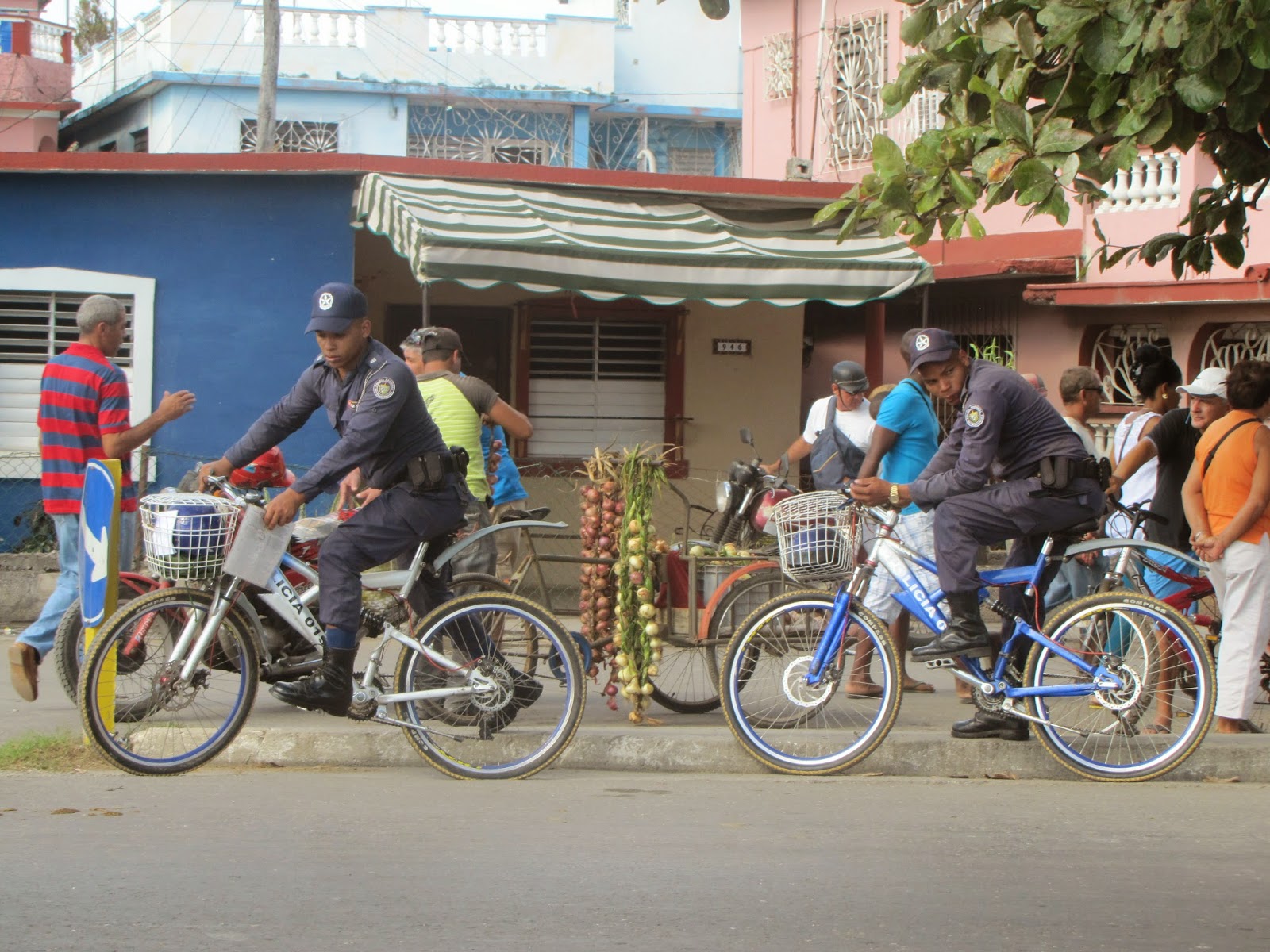
We had to laugh the police will be standing on the side of a busy road watching traffic. No vehicle. No radar. They will point at a vehicle, the vehicle pulls over and they issue a ticket. These two were hanging at the market. 

Communication in Cuba is a struggle 
I wrote this first bit in the different text around the January 10th 2014 in anticipation of sending a broadcast e mail but it didn’t work. I was going to delete it but have decided to leave it as it explained our early trails with communication in Cuba. As you can see now these problems have been resolved, we left Cuba.

If you are reading this it will be because we have broken down paid $10 and taken a bus to a resort at the far east end of Varadero in once again another attempt at Cuban communication. Wow, we can never complain again about the comforts we have. Think outside the beautiful resorts. As foreigners we cannot have cell phones. To make phone calls we have to go to one of the three Cuban communications offices in Varadero to buy a calling card. These cards are often unavailable so we have been trekking from one office to the other. When you have one of these precious beauties in your hand at $20.00 it costs $2 a minute to make a call. As I write this I have still never had a conversation with anyone at home. The internet system works much the same, cards, line ups & communications offices. Were it gets really tricky is there is no wifi available. You must use their computers. Key boards are worn and often missing symbols or set up for foreign languages. It took us 40 minutes and almost $20 to figure out shift 6 was an & sign. I haven't been able to access emails, bank accounts, or FB yet. Sigh...Marc did manage a brief visit to FB on one attempt. Now this part is my fault. I have my passwords memorized into my lap top I cant access my e mails so I cant reset my passwords. Not good. I tell you all this for three reasons. First I want to explain our prolonged absence. Second I wanted to share the trails of our adventure and third I wanted to explain our next anticipated absence.

Eventually we did contact the kids.  in Cuba we had no way to contact the kids as we could not call their cell phones so our wonderful friends Marc and Manon let the kids call us from their phone to the wonderful Debbie's cell phone in Cuba. 49 minutes = $241.41. WOW 

We got to enjoy a wonderful New Year in Cuba

We spent the day on the beach followed by a fantastic lobster dinner then off to enjoy Cuban music and dancing. If their were two things I would have done before traveling it would have been salsa & spanish lessons. 


Our Ride 


I think the best part of cruising is the great friends we have made and enjoyed. 


Joe in Green


Elizabeth


Dianne


Ronald and Dianne


Doug and Alice


Monday, February 10, 2014

The Blue View Notes on Cruising in Cuba

The Blue View Notes on Cruising in Cuba

We arrived in Cuba on Dec 24th.  Clearance in Varadero was actually quite painless.  The official’s: customs or guardia, immigration, doctor, veterinarian and agriculture came onboard to initiate your paperwork and inspections but, the marina handles the end paper process and payment. This make it easier for cruisers.  It also stops the officials from soliciting bribes or as they call it "gifts." Part of the process with customs is that you must provide lists. Crew lists, electronics equipment and motors onboard.

Darsena Marina Varadero is in needs of repairs, but how can you complain at $17 Cuban Convertible Pesos (CUC) or $18.80 Canadian per day.  Staff excellent. Rum cheap. Cervasa cold. Free ice

While in Varadero we met Don and Tricia Barr and their daughter Cheryl. They are from Nova Scotia and it was an honor to meet Don who was the Captain of the Bluenose for over 20 years before retiring.

Don and is family spent over 15 winters cruising Cuba on their sailing vessel “Road to the Isles” The other great thing about our encounter was meeting Captain Cheryl Barr, an experience navigator and marine biologist.  She is also the author of the Cruising Guide to Cuba. Cheryl has
created a very comprehensive guide for navigating Cuba's harbors, anchorages and inside passages. The guide also includes important details about routes, currents, winds, and weather patterns as well as up-to-date information on marinas, provisioning and points of interest.  We found the Cuban charts are very limited and lack details.  I would not cruise Cuba without a guide. We found Cheryl's guide to be the most current and useful.  We loved the information and the layout of the guide. Direct and easy to find.

During our travels I noticed that nothing and I mean nothing goes to waste. They will fix anything and everything with almost nothing.  Here is a great example.  Within a couple hours out of Marathon Florida our auto-helm failed.  For the duration of the 90 NM trip we had to manually steer DevOcean. Thank goodness for good weather. Once in Cuba, I took the auto-helm apart and noticed the six shafts of the sun gear had all sheared off. These stainless steel shafts are approximately an inch long and the diameter of a very fat sewing needle.  The chandlery in Varadero is virtually empty and as you know nothing can be ordered from the US. One of the long live aboard Canadians informed me about a machinist that maybe able to help. To be brief, he manufactured all new shafts for my auto-helm within three days. All for the cost of $15CUC or $16.50 CDN. Wow! At home I probably would have had to purchase an entire new motor or system at some ridicules extravagant amount.  By the way, so far after a few adjustment the Auto-helm works better than before.

Something else we never thought would be an issue was Propane.  Before I left Canada I change the two 10 lbs. propane tanks to two 20 lbs.  Each tank usually will last about us about a month to a month and a half.  After about two weeks in Cuba one of the tanks needed to be refilled. Believe it or not, propane is a government controlled item and not easily bought. We managed to get the tank refilled on the black market. (We found a guy)
Things such as propane (not really propane but butane),fish, lobster and believe it or not potatoes are some of the government control items.  As a tourist you would not be in trouble purchasing but the Cuban seller sure would.  

We left Varadero almost a month to the day of arriving and headed west.  The marina provided us with our cruising permit. Our plan was to visit Havana and from there go around the western tip of the island to the less cruising regulated south side of Cuba. We were cautioned of locations that were restricted (unless for emergency such as weather or breakdown)

We departed from Varadero at 2:30 am after clearing the Guardia and traveled 70 NM arriving at Hemingway Marina at 3:30 PM.  

I'm not sure if I mentioned this before but when cruising in Cuba you have to report to the Guardia at every location you stop at. Your whereabouts are monitored.  Upon arriving in Hemingway we called in on the VHF radio and was inform to dock at the Guardia pier for clearance.  We were boarded, answered a few questions, and more paperwork was filled out. They packaged and held all our flares (considered a weapon) until our departure. Here's the sad part of Hemingway.  The Guardia search DevOcean and then proceeded to ask for gifts.  Linda and I were a little intimidated. It is hard not to be intimidated when officials root through your personal belongings. We did give some razor blades and paid them each $5 CUC’s. Not allot but when you are made to feel you have too the amount is meaningless.  We had the same issue with the acting Port Captain as he insisted we had to give him a gift for his service.  We heard from other cruisers that paid up to $70.00 US in gift/bribes when
clearing in Hemingway. I guess it pays to be cheap. 


After our experience we found a few things that helped.

First, have all your papers ready: zarpe if you are entering from any country other than the US, vessel registration, ownership, copy of passports, equipment list, crew list and pets papers.  

Second, do not invited them inside your vessel to fill the paperwork.  Use your cockpit table and then follow them everywhere in your vessel when they search. Third, do not leave out in full view any electronic equipment such as laptop, cell phone, memory sticks or iPad.

Finally,  we found that a polite firm no to request for gifts/bribes will usually work. We always offered cervasa or a cold drink when they arrived. Now don't get me wrong we loved Cuba and it's not like this everywhere. I'm writing about this issue so that people are informed and know what to expect in Hemingway.  We never had any issues like this in Varadero or anywhere else in Cuba.  After our week of exploring Havana we again cleared the guardia heading to the west end of the Island.   

Our first stop was Bahia Honda a quiet overnight anchorage.  We cleared with the guardia who was a man that rowed his skiff to our vessel to fill out the paperwork.  At this point he also filled out our exit paperwork.  To save himself a return trip he managed to inform us he would change the

paperwork in the morning if we decided to stay longer.  We anchored in great locations such as Cayo Levisa, Cayo Ines de Soto, Punta Abalos and more.  

During this two week period our second propane tank emptied so I connected the tank I had filled in Varadero.  My gauge only read half full.  After a few £#€%{%]!#* we felt we had been ripped off.  We thought no big deal we will get it refilled somewhere.  Well, no such luck. Where we were was a very remote area. There was either no village to speak of or in some areas we were not allowed off the boat.  We finally arrived in Los Moros Cabo San Antonio and were told that no propane would be available anywhere south. Our only option would be to back track over 100 NM to Hemingway. At this point

we were only 112 NM from Isla Mujeres Mexico and a good weather window. So, we are now eating tacos! By the way, once we arrived in Mexico I found out that butane burns hotter than propane and has less tank pressure meaning our tank was full but the gauge was recording lower.  The tank I had filled in Cuba is almost 6 weeks old now and still running strong.  

Last but not least, although we had some issues we felt they were minor and we will for sure return to Cuba. Depending on your wants we highly recommend cruisers to visit. It's a beautiful country, amazing sights, very safe and inexpensive. Many of the cruisers we met were happy in Cuba and returned yearly.

Havana is beautiful the people, the architecture, but the CARS. The cars are amazing and are considered a national treasure.